Why Measurement Is No Longer Enough in Marketing
The industry has mastered measurement. But in a world demanding accountability before the spend, not after, optimization is no longer the highest leverage. The future belongs to decision intelligence.

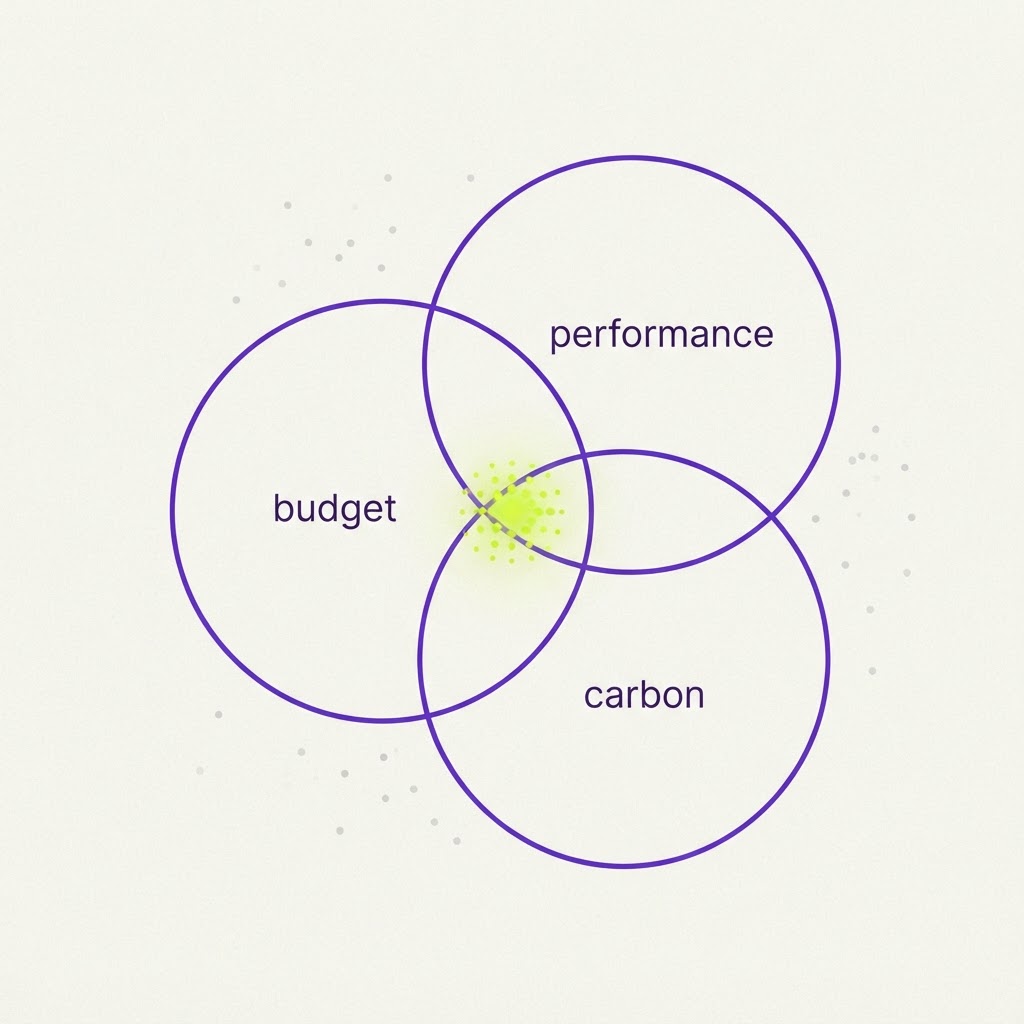
Decision Intelligence is the practice of evaluating cost, performance, and carbon impact before a marketing campaign launches — with full trade-offs visible to decision-makers — and it is emerging as the next evolution in marketing accountability. Marketing is entering a new era where measurement alone is no longer sufficient. In a world demanding responsibility before the spend, not after, the highest leverage is no longer optimization. It is choice.
Why Is Marketing Measurement Entering a New Era of Accountability?
Carbon tracking, sustainability reporting, and efficiency metrics are no longer optional. They are becoming the baseline expectation. Companies face pressure from both sides: internal stakeholders demanding ROI clarity, and external frameworks like CSRD, climate disclosure requirements, and tightening greenwashing regulations demanding responsibility.
Measurement is no longer optional. It's expected.
But expectation is not the same as sufficiency. The industry has mastered measurement. What it has not yet mastered is decision-making.
What Does the Current "Measure to Optimize" Model Look Like?
Today's dominant marketing model follows a familiar sequence:
- A campaign launches
- Data is collected — performance metrics, carbon data, engagement figures
- Teams optimize based on results
- A report is generated
- Learnings are applied to the next campaign
This model has been genuinely valuable. It improved efficiency. It brought visibility into what's working. It created better reporting structures and more accountable teams.
But it has a fundamental blind spot.
What Is the Biggest Blind Spot in Modern Marketing?
By the time you measure, the budget is already spent. The emissions are already created. The impact is already locked in.
You can optimize the next campaign. But you cannot undo the last one.
The most important decision in marketing is not how you optimize. It's whether the decision should have been made in the first place.
This is not a minor inefficiency. It is a structural flaw in how the entire industry operates.
Why Are Marketing Decisions Still Being Made Without Full Visibility?
Today, before a campaign goes live, this is the reality for most marketing teams:
- Performance is estimated loosely, often based on gut feel or historical averages
- Carbon impact is rarely, if ever, calculated pre-launch
- Trade-offs between cost, reach, and sustainability are not visible side by side
- Regulatory implications are not considered in the pre-decision environment
- Waste — inefficient channels, low-quality inventory, non-converting audiences — is identified only after money is spent
We have built sophisticated measurement systems for the past. But the decision — the moment that actually determines the outcome — still happens in the dark.
Benchmark Data: The Scale of the Pre-Decision Problem
| Marketing Challenge | Industry Reality |
|---|---|
| Digital ad spend lost to waste & fraud | Estimated at 23–40% of total programmatic budgets |
| Marketers who calculate carbon pre-launch | Fewer than 5% of enterprise marketing teams |
| Companies now subject to CSRD reporting | Over 50,000 companies across the EU by 2026 |
| Scope 3 emissions from digital advertising | Can represent up to 90% of a brand's media carbon footprint |
| CMOs reporting board-level scrutiny on sustainability | 61% of CMOs cite ESG accountability as a growing priority (2024) |
These numbers reveal a clear gap: the sophistication of marketing measurement tools vastly outpaces the primitiveness of the pre-decision environment. When up to 40% of programmatic spend is lost before a team can even react, and fewer than 1 in 20 enterprise teams calculates carbon before launch, the structural cost of deciding in the dark becomes impossible to ignore.
What Is Decision Intelligence in Marketing?
Decision Intelligence in marketing is the practice of evaluating cost, performance, and carbon impact together — before execution — with clear trade-offs and constraints visible to the team making the call. It is not a measurement tool. It is not an optimization engine. It is a decision layer that sits upstream of everything else.
The shift can be summarized simply:
| From | To |
|---|---|
| Measurement | Decision |
| After | Before |
| Reporting | Intelligence |
| Efficiency | Intentionality |
| Reactive | Proactive |
This is not an incremental improvement to existing workflows. It is a categorical shift in where marketing intelligence is applied.
How Is Decision Intelligence Different From Measurement and Optimization?
These three capabilities are often conflated, but they operate at entirely different points in the marketing lifecycle:
| Capability | When It Operates | What It Answers |
|---|---|---|
| Measurement | After execution | What happened? |
| Optimization | During execution | What can we improve? |
| Decision Intelligence | Before execution | What should happen? |
Measurement tools tell you what happened. Optimization tools improve what is running. Decision Intelligence defines what should happen.
It is the difference between reporting, reacting, and deciding.
What Does "Before Execution" Actually Mean in Practice?
Before a campaign goes live, teams operating with Decision Intelligence should be able to:
- Simulate outcomes across multiple scenarios before committing budget
- Estimate the full carbon footprint — including Scope 3 media emissions — at the planning stage
- Identify waste proactively — inefficient channels, low-quality inventory, audiences unlikely to convert
- Compare scenarios side by side across cost, reach, performance, and sustainability dimensions
- Apply guardrails — budget ceilings, sustainability thresholds, compliance requirements — before a single dollar is committed
This is not a futuristic concept. It is the gap that exists today between the sophistication of our measurement tools and the primitiveness of our pre-decision environment.
Why Does This Shift Matter Now for CMOs?
Several forces are converging simultaneously:
- Regulatory scrutiny is increasing. CSRD is live. Greenwashing enforcement is expanding across the EU and beyond.
- CMOs are being asked to justify return on responsibility, not just return on investment.
- Digital ad waste is becoming a visible liability — both financially and environmentally.
- Scope 3 marketing emissions are entering the boardroom conversation, with procurement and sustainability teams now scrutinizing media plans.
- Optimization alone cannot satisfy these demands. A perfectly optimized campaign that shouldn't have run at all is not a success.
The pressure is not coming from one direction. It is structural, regulatory, financial, and reputational — all at once.
What Is Carbon-First Marketing Decision Intelligence?
A new category is emerging in marketing infrastructure. Not another measurement tool. Not a faster optimization engine. But a decision layer — one that sits before execution and asks the questions that have never been systematically asked before.
In a Carbon-First Decision Intelligence model:
- Carbon is not a report generated after the fact — it is a decision variable considered before anything launches
- AI does not just execute campaigns — it evaluates, questions, and guides the choices that determine everything downstream
- Sustainability is not a compliance checkbox — it is a live input in every campaign planning decision
- Trade-offs between cost, reach, and environmental impact are visible and navigable before spend is committed
This represents the next layer of marketing infrastructure — one that fundamentally changes when intelligence is applied.
What Will Define the Future of Marketing Performance?
The future of marketing will not be defined by who measures more, or who optimizes faster. It will be defined by who makes better decisions before anything goes live.
In a world of limited resources and increasing responsibility, the highest leverage point is not at the reporting stage. It is not at the optimization stage. It is at the moment of choice — before a single impression is served, before a single dollar is committed, before a single gram of carbon is emitted.
Because in a world demanding accountability, optimization is no longer the highest leverage.
It is choice.
Frequently Asked Questions
Q: What is the difference between marketing measurement and Decision Intelligence?
A: Marketing measurement tells you what happened after a campaign runs. Decision Intelligence is applied before execution — it evaluates cost, performance, and carbon impact simultaneously so teams can make informed choices before any budget is committed. Measurement is retrospective; Decision Intelligence is prospective.
Q: Why is marketing measurement no longer enough on its own?
A: Measurement captures outcomes after the fact, when spend is already locked in and emissions already generated. In an environment of tightening regulations (CSRD, greenwashing enforcement), rising ad waste, and board-level ESG scrutiny, the ability to make better decisions before launch has become more valuable than the ability to report better after it.
Q: What are Scope 3 media emissions and why do they matter for marketers?
A: Scope 3 emissions refer to indirect emissions in a company's value chain — in marketing, this includes the carbon generated by digital advertising delivery across servers, devices, and networks. These can represent up to 90% of a brand's total media carbon footprint, making them a significant and largely unmeasured liability for enterprise marketing teams.
Q: What regulations are driving the shift toward carbon-first marketing?
A: The EU's Corporate Sustainability Reporting Directive (CSRD) requires over 50,000 companies to disclose detailed sustainability data by 2026. Combined with expanding greenwashing enforcement from the EU Green Claims Directive and FTC guidelines, CMOs face growing legal and reputational risk from unsubstantiated sustainability claims and untracked carbon exposure.
Q: Is Decision Intelligence in marketing a real technology category or just a concept?
A: It is an emerging technology category. While most marketing stacks are built around measurement and optimization tools, a new layer of pre-execution intelligence is developing — one that uses AI to simulate campaign outcomes, estimate carbon footprints, flag regulatory risks, and surface trade-offs before spend is committed. This is the gap between today's marketing infrastructure and what accountability-first marketing demands.
Key Takeaways
- Measurement is necessary but no longer sufficient. The industry has mastered post-campaign reporting; the next frontier is pre-decision intelligence applied before any budget is committed.
- The fundamental blind spot is timing. By the time measurement occurs, spend is locked in, emissions are generated, and impact is fixed — optimization can only affect the next campaign, not the current one.
- Decision Intelligence is a categorical shift, not an incremental one — moving intelligence from after execution to before it, with cost, performance, and carbon evaluated simultaneously.
- Regulatory and ESG pressure is structural, not cyclical. CSRD, greenwashing enforcement, and Scope 3 emissions disclosure are creating lasting accountability requirements that measurement tools alone cannot satisfy.
- The highest leverage in marketing is choice. In a resource-constrained, accountability-driven environment, the teams that win will be those who make better decisions before anything launches — not those who optimize fastest after the fact.