Why AI Media Optimization Isn't the Same as Decision Intelligence
Optimization asks 'How can I execute this better?' Decision intelligence asks 'Should I spend here in the first place?' Why most marketing AI refines the wrong decision instead of questioning it.

There's a quiet but important difference between optimizing a marketing decision and having the intelligence to question whether the decision should be made at all.
Most of the technology sold to marketing teams as "AI" today is optimization. It asks a narrow, useful question: "How can I execute this better?"
Decision intelligence asks a different question: "Should I spend here in the first place?"
Both are valuable. They are not the same thing. And confusing the two is why so much marketing budget keeps getting optimized into the wrong place.
What optimization actually does
Optimization platforms are built to make an existing plan more efficient. They take a goal as given — a budget, a channel, an audience, a target — and tune the execution toward that goal.
They answer questions like:
- How do I lower the CPM on this line item?
- How do I improve click-through on this creative?
- How do I shift delivery toward the highest-performing hour of the day?
- How do I reallocate within a fixed channel mix?
This is real work. It makes execution sharper. But it accepts the plan as the starting point. It does not ask whether the plan itself is the right one.
Optimization makes the current decision faster, cheaper or more precise. It rarely asks whether the current decision is correct.
What decision intelligence does
Decision intelligence starts one step earlier. Before it asks how to execute, it asks whether the spend belongs where it is — and whether the signals, read together, point somewhere else.
It answers questions like:
- Is this budget creating incremental commercial value, or just buying frequency?
- Is the cost worth the performance we're actually getting?
- Is the audience we're paying to reach the audience that drives the outcome?
- Is the carbon we're generating justified by the business return?
- Should we keep, reduce, reallocate, test or grow — here, now?
Notice the difference. Optimization refines the answer to a question someone already chose. Decision intelligence questions the question itself.
Why the difference matters in practice
Imagine a campaign line where frequency is high, incremental reach is negative, and carbon intensity is elevated.
- An optimization response would try to make that line cheaper and tighter. It would lower the CPM. It would shift delivery. It would improve the efficiency of the spend inside the same line.
- A decision intelligence response would ask whether the spend should be there at all. It would connect cost, performance, waste and carbon, find that the line is generating emissions and budget cost without incremental return, and recommend reducing it — with part of the budget reallocated to higher-efficiency inventory.
The first makes a weak decision more efficient. The second replaces a weak decision with a better one.
That's the gap. And it's the gap that determines whether marketing budget compounds or just cycles.
The signal problem underneath
The reason optimization can't reach the decision-intelligence question is that optimization doesn't see the full signal set. It typically works inside one platform, one channel, or one dimension of performance.
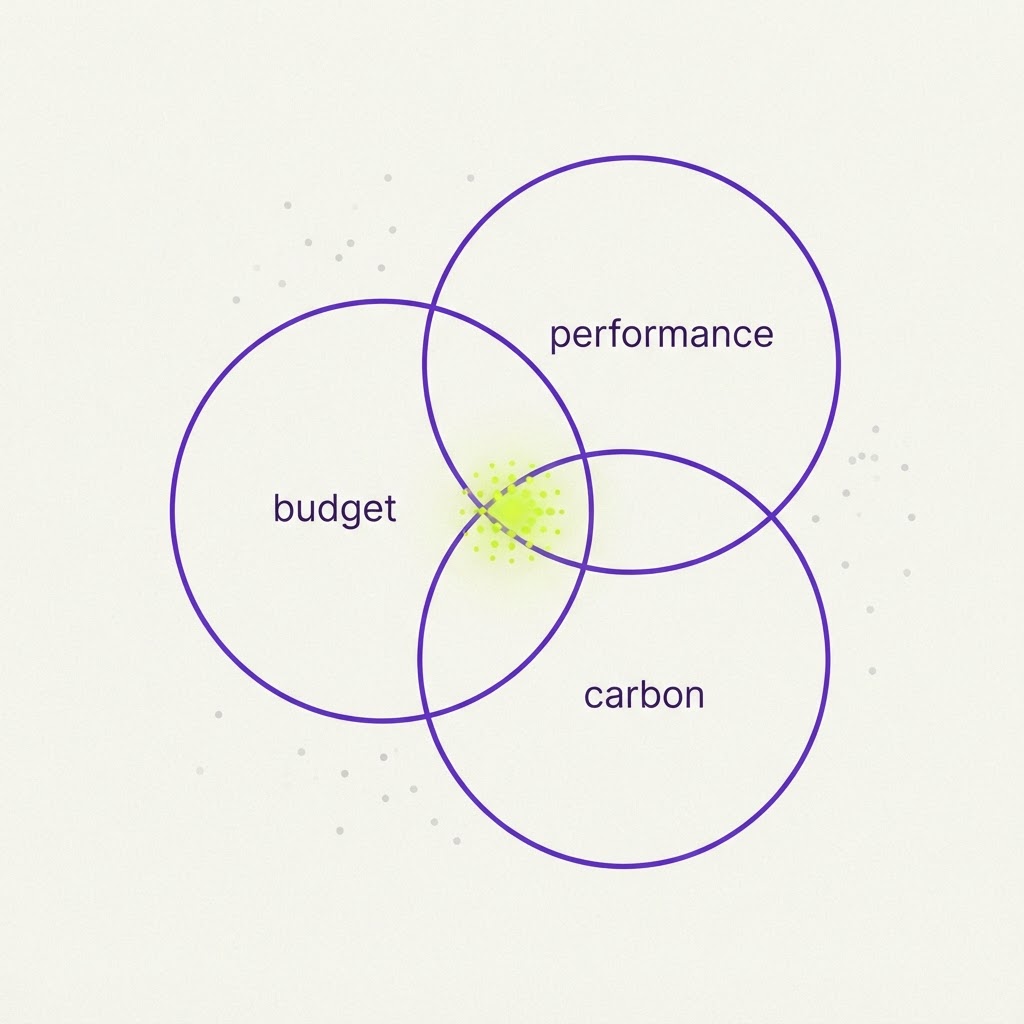
Decision intelligence requires reading signals that live in different places, on different timelines, owned by different teams:
- Cost — in media platforms and agency spreadsheets.
- Performance — in attribution and analytics.
- Waste — in frequency, overlap and reach.
- Audience — in CRM and data warehouses.
- Carbon — in sustainability reporting.
- Commercial outcomes — in finance and revenue systems.
Optimization reads one or two of these. Decision intelligence reads them together, finds the intersections, and explains why a different decision would create a better outcome.
The stack stays — the intelligence gets added
Here's the practical point: this isn't a choice between optimization and decision intelligence. Most organizations need both.
Optimization platforms keep doing what they do well — refining execution inside the plan. Decision intelligence sits above them, connects the signals across the ecosystem, and answers the question of what the plan should be in the first place.
The media execution layer stays. The platforms stay. The agency relationships stay. What gets added is an intelligence layer that turns disconnected signals into explainable recommendations — before the money moves, not after.
The question to ask your tools
If you want to know which one you're buying, ask one question:
Does this tool tell me how to do what I already decided to do — or does it tell me whether I should be doing it at all?
The first is optimization. It's useful.
The second is decision intelligence. It's where the real money is — because the biggest waste in marketing isn't inefficient execution. It's efficiently executing the wrong decision.
WE7 is built to answer the second question. See how it connects your signals into decisions before the money moves.