Where Does 30–40% of Your Marketing Budget Actually Go?
30–40% of marketing budgets produce no measurable return. The waste shows up twice — once as an unexplained line item, once as emissions you didn't ask for. Here's how to find it before you spend it.

Marketing budget waste is the measurable portion of campaign spend — typically 30–40% of total marketing budgets — that produces no attributable return on investment, and which correlates directly with a campaign's unnecessary carbon emissions. This dual waste (financial and environmental) originates from the same source: inefficient vendor chains, mis-targeted impressions, and redundant processes that inflate both cost and carbon footprint simultaneously.
Most CMOs can tell you exactly what they spent last quarter. Fewer can tell you exactly where it went — down to the channel, the placement, the vendor in the chain that never should have gotten a dollar in the first place.
That gap isn't a reporting problem. It's a decision problem. And on average, it costs marketing organisations 30 to 40 percent of their budget in spend that produces no measurable return.
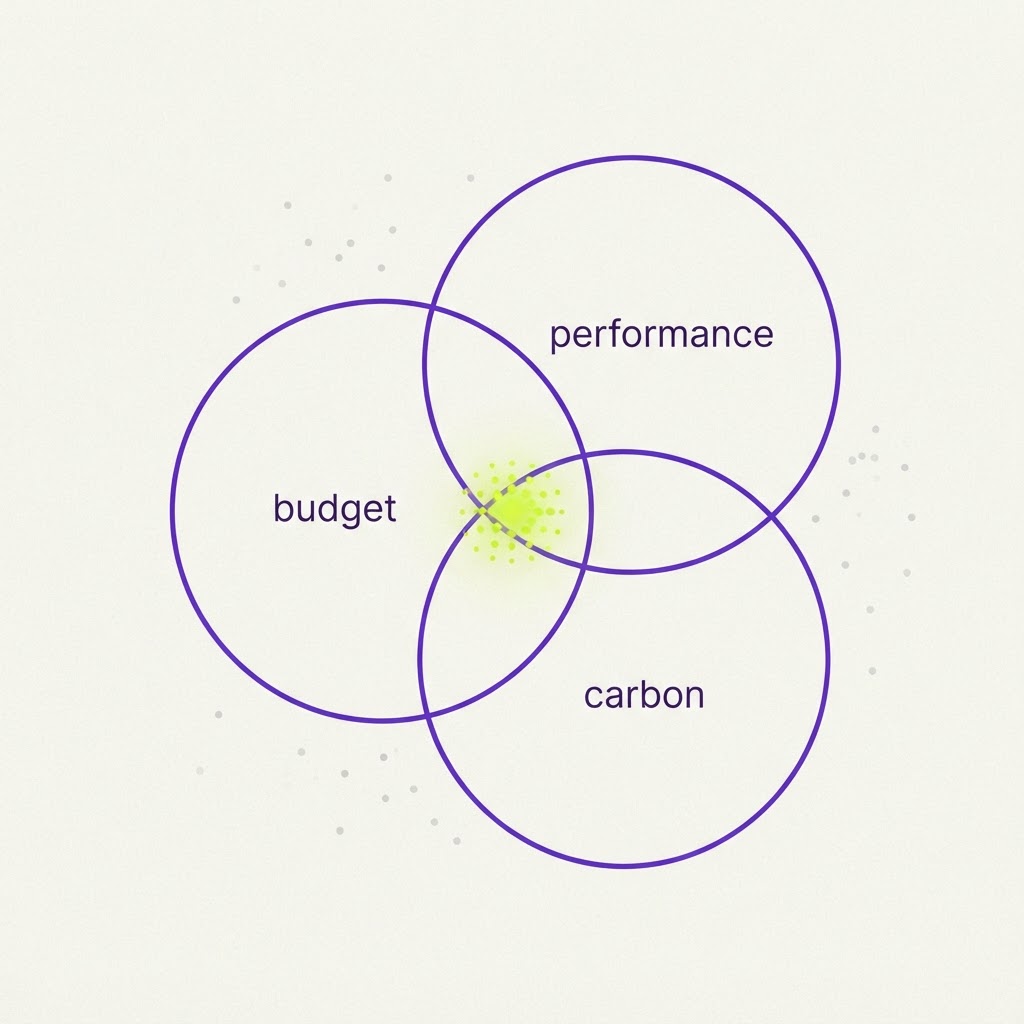
Here's the part most teams miss: that wasted spend and your campaign's carbon footprint are, in large part, the same thing. Every impression served to the wrong audience, every redundant vendor in a bloated supply chain, every asset re-rendered because no one flagged the inefficiency earlier — it all shows up twice. Once as a line item you can't fully explain. And once as emissions no one asked for.
Is Carbon Waste the Same as Budget Waste?
It's tempting to treat sustainability reporting and budget efficiency as two separate conversations — one for the CFO, one for the sustainability team. They're not.
The inefficiencies that inflate a campaign's carbon footprint are, almost without exception, the same inefficiencies that inflate its cost:
| Inefficiency Type | Budget Impact | Carbon Impact |
|---|---|---|
| Excess vendor hops in supply chain | Margin stacking eats working budget | Extra data transfers add emissions |
| High impressions, low engagement inventory | Burns spend with no ROI | Burns energy with no value |
| Redundant asset rendering | Increases production cost | Increases compute emissions |
| Mis-targeted audience delivery | Wasted CPM spend | Wasted server and delivery energy |
When you find one type of waste, you've usually found the other. This reframes the core question CMOs should be asking — not "how do we report our footprint", but "where in this budget are we paying twice for the same waste — once in dollars, once in emissions?"
Learn more about how financial and environmental efficiency intersect in Carbon-First Marketing.
Why Is Marketing Budget Waste So Hard to Detect Right Now?
Two forces are converging that make this an unusually important moment to ask where your budget actually goes.
1. CFOs Are Demanding Granular Justification
Budgets are under intense scrutiny. CFOs are asking marketing to justify spend at a level of granularity that wasn't required two years ago. "It performed well" is no longer a sufficient answer on its own. Marketing teams that cannot trace spend to measurable outcomes at the channel and vendor level are increasingly exposed.
2. Regulatory Reporting Requirements Are Tightening
The EU's Corporate Sustainability Due Diligence and Green Claims frameworks — including obligations taking effect this September — are pushing Scope 3 marketing emissions from a voluntary disclosure into an expected one for many organisations. Key implications:
- Teams with clean, campaign-level carbon data will meet reporting requirements as a byproduct of work they were already doing
- Teams without this data will be building the entire measurement layer under deadline pressure
- Organisations operating in the EU market face the earliest and strictest obligations
- Similar frameworks are advancing in the UK, Australia, and at the SEC level in the US
Neither of these is purely a sustainability story. They're both a preparedness story — and preparedness starts with knowing where the money actually goes before you commit it, not after the campaign closes.
What Do the Numbers Actually Show? Key Benchmark Data
While exact figures vary by organisation size and sector, the consistent benchmarks across industry research point to:
- 30–40% of marketing budget spend produces no measurable return on investment
- A significant portion of programmatic display spend never reaches a human audience due to invalid traffic and supply chain inefficiency
- Organisations that audit vendor chain transparency typically identify 15–25% of working media budget as recoverable through renegotiation or consolidation
- Carbon emissions from wasted impressions and redundant data transfers can represent 20–35% of a campaign's total digital carbon footprint — waste that disappears when the financial inefficiency is resolved
These figures reinforce a consistent pattern: organisations that address budget efficiency and carbon efficiency together find that each discipline accelerates the other. Explore how the Campaign Carbon Score surfaces these overlapping inefficiencies before spend is committed.
How Should the Measurement Approach Change?
From Reporting After to Deciding Before
Most measurement tools tell you what happened. That's useful for the record, but it's the wrong moment to catch waste — by the time a report lands, the budget is already spent.
The more useful question is asked before commitment:
Given this media plan, this vendor mix, this creative approach — where is the inefficiency likely to show up, and what would it cost in dollars and in emissions if we proceed as planned?
That requires a fundamentally different kind of tool than a dashboard. It's a decision layer that sits in front of the spend, not a report that sits behind it. Numbers on one page, before sign-off — not a quarterly retrospective.
The measurement timing comparison:
| Approach | When It Runs | What It Catches | Cost of Findings |
|---|---|---|---|
| Post-campaign reporting | After spend is committed | Historical waste | Cannot be recovered |
| Pre-commitment decision layer | Before sign-off | Predicted inefficiency | Fully avoidable |
You can evaluate your own campaign's efficiency profile using the Campaign Carbon Score — a pre-commitment tool that surfaces both cost and carbon waste before budgets are locked.
How Do You Find Budget Waste Before It's Spent? 4 Practical Steps
-
Audit one campaign, fully. Not the whole media plan — one representative campaign, traced end to end through the vendor and inventory chain. Research consistently shows that most inefficiency is concentrated in a small number of placements or partners. Teams that do this audit are typically surprised by how few line items account for the majority of waste.
-
Ask vendors for the full chain, not just the top line. A media partner that can show you where a dollar actually travels — and how much of it survives to reach a real audience — is showing you where the waste lives. Partners who cannot or will not provide this transparency are a signal in themselves.
-
Treat carbon data as budget data. If your sustainability reporting and your media performance reporting live in different systems, owned by different teams, you are very likely missing the overlap between them. Organisations that have unified these data streams consistently find actionable cost savings as a direct output of their carbon measurement work.
-
Build the habit before the deadline forces it. Teams that start measuring campaign-level efficiency now will meet upcoming reporting requirements almost incidentally. Teams that wait will be doing both under time pressure — which typically means higher cost and lower quality data.
Why Does This Matter for CMOs Specifically?
The convergence of CFO scrutiny and regulatory obligation means that marketing leaders are now accountable for two things that used to be managed separately: financial efficiency and environmental disclosure. The good news is that they share the same data foundation.
A CMO who can walk into a budget review and demonstrate — before the campaign runs — which line items carry the highest waste risk, what that waste would cost in dollars, and what it would generate in unnecessary emissions, is operating at a level of preparedness that is increasingly rare and increasingly valued.
That's not a sustainability argument. That's a leadership argument.
Frequently Asked Questions
Q: Why do 30–40% of marketing budgets produce no measurable return?
A: The waste typically accumulates across three layers: supply chain inefficiency (too many vendor hops between advertiser and publisher, each taking margin), audience targeting inefficiency (impressions served to audiences unlikely to convert), and process inefficiency (assets re-produced, campaigns duplicated, or placements continued past the point of diminishing returns). Each layer compounds the others, and because reporting is usually retrospective, the waste is rarely caught before it's committed.
Q: How are marketing carbon emissions and budget waste connected?
A: They share the same root causes. Every redundant data transfer in a bloated supply chain consumes both budget (through margin stacking) and energy (through server and network activity). Every impression delivered to an unengaged audience wastes both spend and the energy required to serve that impression. Resolving financial inefficiency almost always reduces carbon emissions as a direct consequence — they are not separate problems requiring separate solutions. Carbon-First Marketing explores this relationship in detail.
Q: What are Scope 3 marketing emissions and why do they matter for budget planning?
A: Scope 3 marketing emissions are the indirect emissions generated by a brand's marketing activity — including the energy consumed by ad serving infrastructure, data transfers, video streaming, and the vendor ecosystem used to deliver campaigns. They matter for budget planning because emerging EU and global regulations are requiring organisations to disclose and reduce them, and because the measurement process for Scope 3 emissions naturally surfaces the same supply chain inefficiencies that inflate campaign cost.
Q: When should campaign efficiency be evaluated — before or after spend is committed?
A: Before. Post-campaign reporting is valuable for learning but cannot recover wasted spend. A pre-commitment evaluation — using a tool like the Campaign Carbon Score — allows teams to identify predicted inefficiency in a media plan, vendor mix, or creative approach before budget is locked. This is the shift from measurement as a reporting function to measurement as a decision function.
Q: What's the fastest way to start identifying marketing budget waste?
A: Pick one representative campaign and trace it end to end through the vendor and inventory chain. Most teams find that the majority of waste is concentrated in a small number of placements or partners — making it tractable to address without a full-programme overhaul. Simultaneously, ask your media partners to document the full path a dollar takes from your budget to a real audience impression. Partners who cannot provide this transparency are themselves a signal of where waste is likely concentrated.
Key Takeaways
- Budget waste and carbon waste are the same problem. The inefficiencies that inflate a campaign's cost — excess vendor hops, mis-targeted impressions, redundant processes — are the same ones that inflate its carbon footprint. Solving one solves the other.
- 30–40% of marketing spend typically produces no measurable return, concentrated in a small number of placements, partners, and process inefficiencies that are identifiable before spend is committed.
- 15–25% of working media budget is typically recoverable through vendor chain audits, renegotiation, or consolidation — findings that emerge directly from transparency requests most teams have never made.
- Regulatory pressure is accelerating the timeline. EU Scope 3 marketing emissions disclosure requirements taking effect this year mean that campaign-level carbon and efficiency data is moving from optional to expected — teams that build this capability now avoid building it under deadline.
- The measurement moment matters. Post-campaign reporting records what happened; pre-commitment evaluation changes what will happen. The financial case for shifting from retrospective dashboards to forward-looking decision tools is the same as the sustainability case. Use the Campaign Carbon Score to benchmark your next campaign before budgets are locked.