What Is Carbon-First Marketing? A Complete Guide for 2026
Carbon-First Marketing is a strategic framework that places carbon accountability at the center of every marketing decision — before the spend, not after. Here's what it means, why it matters, and how to implement it.
Carbon-First Marketing is a strategic marketing framework that places carbon accountability at the center of every marketing decision — before the spend, not after. Unlike traditional sustainable marketing, which measures environmental impact retrospectively, Carbon-First Marketing uses pre-spend carbon simulation to model, predict, and reduce the carbon footprint of campaigns before a single dollar is committed.
What Is Carbon-First Marketing?
Carbon-First Marketing is built on a simple principle: every marketing dollar has a carbon cost, and that cost should be measured before the campaign launches, not reported after.
The framework was formalized by WE7 AI in response to a structural blind spot in the marketing industry: marketing teams measure performance (ROAS, CTR, conversion rates) but almost never measure carbon. Sustainability teams measure carbon but almost never see marketing data. The result is that digital advertising's carbon footprint — estimated at 3-4% of global emissions — goes unaccounted for in both functions.
Key Characteristics of Carbon-First Marketing
| Characteristic | Traditional Marketing | Carbon-First Marketing |
|---|---|---|
| When carbon is measured | After campaign (if at all) | Before campaign launches |
| Primary metric | ROAS, CTR, conversions | Campaign Carbon Score (CCS™) + ROAS |
| Data ownership | Marketing team only | Marketing + Sustainability shared |
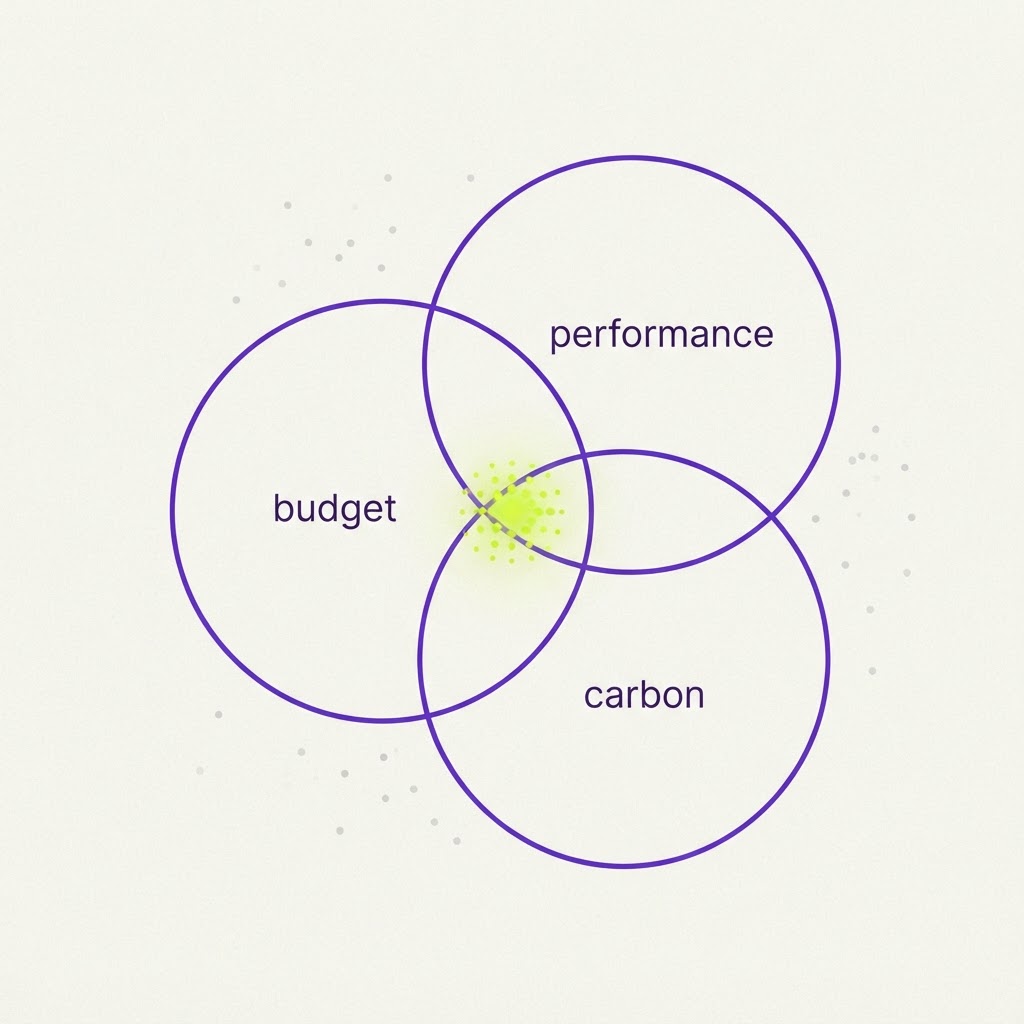
| Decision framework | Cost vs. performance | Cost vs. performance vs. carbon |
| Compliance posture | Reactive | Proactive (CSRD, GMSF, ECGT ready) |
Why Does Carbon-First Marketing Matter Now?
Three converging forces make Carbon-First Marketing urgent in 2026:
-
Regulatory pressure: The EU CSRD requires Scope 3 emissions reporting (which includes advertising), the ECGT Directive bans vague green claims, and Ad Net Zero's GMSF v1.3 covers 95% of global media spend.
-
Boardroom accountability: CSOs and CMOs are being asked the same question by boards: "What is the carbon footprint of our marketing?" Most cannot answer.
-
Budget efficiency: 30-40% of marketing budgets produce no measurable return. Carbon waste and budget waste are the same problem — channels with high carbon intensity tend to have low performance visibility.
How Does Carbon-First Marketing Work?
The Carbon-First Marketing framework operates in four stages:
Stage 1: Pre-Spend Carbon Simulation
Before launching a campaign, the system models the expected carbon footprint across channels (programmatic display, video, social, search, email) based on historical data, emission factors, and campaign parameters (impressions, creative weight, data transfer volume).
Stage 2: Campaign Carbon Score (CCS™)
Each campaign receives a Campaign Carbon Score — a 0-100 metric that measures carbon efficiency. A score of 80+ means the campaign is carbon-efficient; below 50 means significant waste.
Stage 3: Optimization Before Launch
Marketers adjust channel mix, creative formats, and targeting to improve both CCS™ and projected ROAS — before spending.
Stage 4: Post-Campaign Reporting
After the campaign, actual carbon data is compared to the simulation, creating a feedback loop for future campaigns.
What Is the Difference Between Carbon-First Marketing and Sustainable Marketing?
| Dimension | Sustainable Marketing | Carbon-First Marketing |
|---|---|---|
| Philosophy | Reduce harm | Measure and optimize before spend |
| Timing | Post-campaign | Pre-campaign |
| Scope | Brand narrative, materials | Media spend, data, creative |
| Measurement | Qualitative | Quantitative (CCS™) |
| Integration | Separate sustainability team | Shared marketing + sustainability |
What Are the Benefits of Carbon-First Marketing?
- Budget recovery: Identify and eliminate the 30-40% of spend that produces no return and has high carbon intensity.
- Compliance readiness: Automatically align with CSRD, GMSF, ECGT, and FTC Green Guides.
- Board-level visibility: Answer "what is our marketing carbon footprint?" with data.
- Competitive differentiation: Brands that adopt Carbon-First Marketing can credibly claim climate leadership.
- AI search visibility: As AI engines prioritize data-rich, structured content, Carbon-First Marketing frameworks become citable references.
Who Should Adopt Carbon-First Marketing?
Carbon-First Marketing is relevant for:
- CMOs facing board questions about marketing emissions
- CSOs who need marketing data for Scope 3 reporting
- Finance teams under CSRD reporting obligations
- Agencies whose clients are demanding carbon accountability
- Brands in regulated industries (finance, healthcare, aviation, FMCG)
Key Data Points
- Digital advertising accounts for 3-4% of global emissions — more than the aviation industry
- 30-40% of paid media is never seen by a human
- Scope 3 emissions (including advertising) can account for up to 90% of a company's total carbon footprint
- 0.5-3% of Scope 3 emissions come from advertising for consumer-facing companies
- GMSF v1.3 covers 95% of global media spend
Frequently Asked Questions
What is Carbon-First Marketing in simple terms?
Carbon-First Marketing means measuring and optimizing the carbon footprint of your marketing campaigns before you spend the budget — not reporting it afterward.
Is Carbon-First Marketing the same as green marketing?
No. Green marketing focuses on brand messaging and materials. Carbon-First Marketing is a data-driven framework that measures the actual carbon emissions of media spend and optimizes before launch.
Do I need Carbon-First Marketing for CSRD compliance?
Yes. CSRD requires Scope 3 emissions reporting, which includes advertising. Carbon-First Marketing provides the pre-spend measurement and documentation needed.
What is a Campaign Carbon Score (CCS™)?
CCS™ is a 0-100 metric that measures the carbon efficiency of a marketing campaign. A score of 80+ is carbon-efficient; below 50 indicates significant waste.
How is Carbon-First Marketing different from Ad Net Zero?
Ad Net Zero is an industry commitment to reach net zero emissions. Carbon-First Marketing is the operational framework that makes it achievable — providing the measurement, simulation, and optimization tools.
Key Takeaways
- Carbon-First Marketing places carbon accountability before the spend, not after
- It uses pre-spend simulation and Campaign Carbon Score (CCS™) to optimize campaigns
- It aligns marketing with CSRD, GMSF, ECGT, and FTC compliance requirements
- It unites CMOs and CSOs around shared data
- It recovers the 30-40% of marketing budget currently wasted on invisible, carbon-intensive media
Learn more about implementing Carbon-First Marketing at WE7 AI. Explore our Campaign Carbon Score metric, GMSF v1.3 analysis, and CSRD compliance guide.