
The Hidden Cost of Media Waste: Budget, Performance and Carbon
Why wasted impressions cost more than media dollars — the three hidden costs of media waste: budget, performance and carbon, and why they only become visible when the signals are read together.
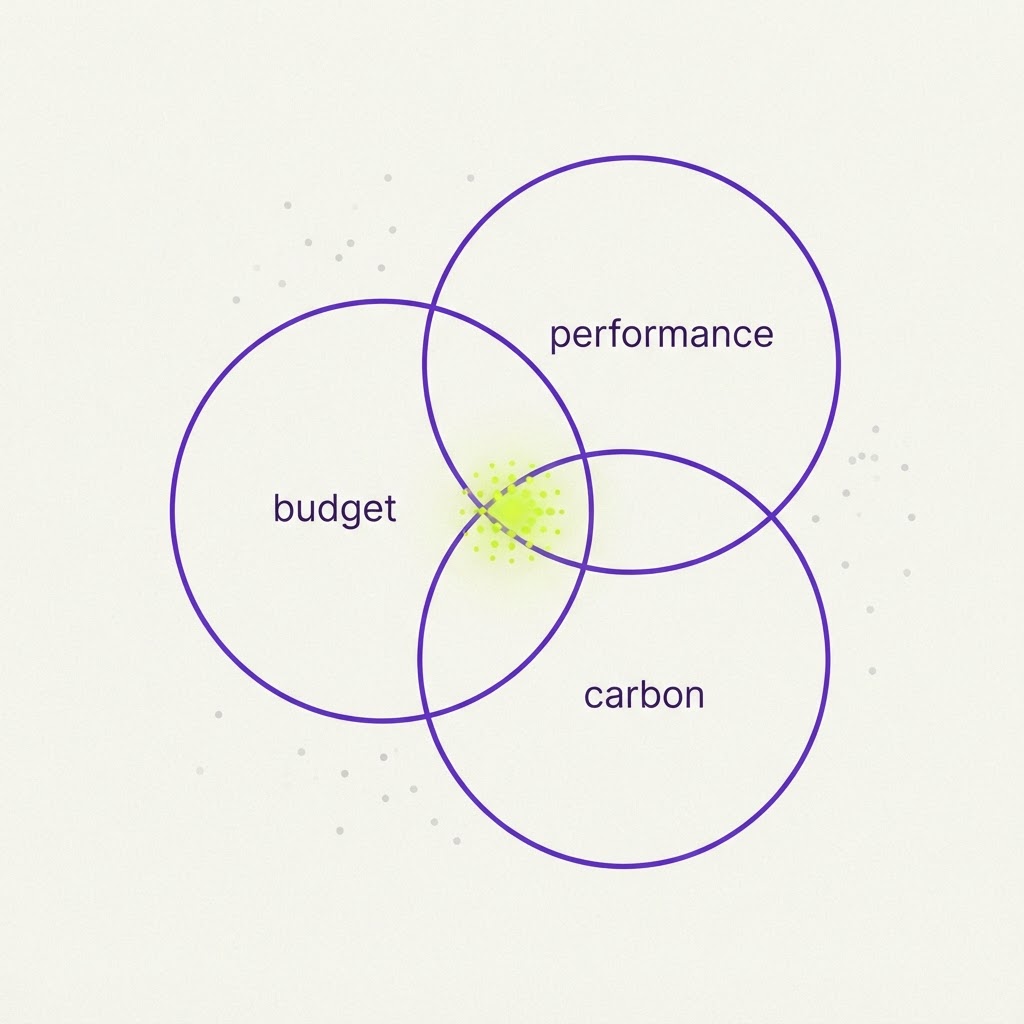
A wasted impression is not free. It looks free, because it doesn't show up as a line item. But it costs more than the media dollar that bought it.
When an impression is wasted — served to the wrong audience, shown too many times to the same person, placed on low-quality inventory, or delivered into a context that can't drive a commercial outcome — the organization pays three times: in budget, in performance, and in carbon.
Most teams only see the first cost. The other two are invisible until someone connects the signals.
Cost one: the budget you can see
This is the easy one. Wasted impressions consume budget that could have reached someone who mattered. A $5M programmatic line with a 6.8 frequency against a 3.9 benchmark isn't just inefficient — it's budget that has already been spent on diminishing returns.
Budget waste is the cost most teams measure. It's also the cost they measure too late.
Cost two: the performance you lose
Wasted impressions don't just spend money. They spend opportunity. Every dollar locked into excess frequency is a dollar that didn't go to higher-efficiency inventory, a better audience, or a new growth hypothesis.
The performance cost of waste shows up as:
- Negative incremental reach — you're paying to reach people you already reached.
- Declining return on incremental spend — each added dollar buys less than the one before it.
- Audience fatigue — the same message, over-served, begins to work against the brand.
- Lower commercial conversion per impression — because the impressions are going to the wrong people, or the same people, too often.
A dashboard can show each of these in isolation. It can't show that they are the same problem.
Cost three: the carbon no one is counting
This is the cost that's newest, and the one most likely to be missed.
Every impression has a carbon footprint — the energy of delivery, the data transfer, the servers, the programmatic supply chain. When an impression is wasted, that carbon is wasted too. You pay for it environmentally, and you get nothing commercially in return.
So a high-frequency, low-incremental-reach campaign isn't just inefficient budget. It's carbon generated for no business return. That's the hidden intersection: waste is simultaneously a budget problem, a performance problem, and an emissions problem.
Until those three are read together, the organization optimizes one and ignores the other two.
Why the costs stay hidden
The three costs stay hidden because they live in three different places:
- Budget lives in finance and media platforms.
- Performance lives in analytics and attribution.
- Carbon lives in sustainability reporting, if it's measured at all.
Nobody owns the intersection. So nobody acts on it.
The result is a familiar pattern: the media team reduces CPM, the analytics team flags frequency, the sustainability team flags emissions — and the campaign keeps running the same way, because no single view connects the three.
What changes when the signals connect
When cost, performance, waste and carbon are read together, a decision becomes visible that none of them could see alone:
Reduce excess frequency and reallocate part of the budget to higher-efficiency inventory.
That one decision:
- Recovers budget — money stops going to diminishing returns.
- Improves performance — incremental reach and conversion per impression rise.
- Reduces carbon — fewer wasted impressions means lower emissions for the same or better commercial outcome.
One decision. Three costs, addressed together. That's the value of reading the intersection.
The bigger point
Media waste is not a media problem. It's an intelligence problem.
The evidence is already in your organization. The signals already exist. What's missing is a layer that connects them — and turns the intersection into a decision before the money moves, not after.
That's what WE7 is built to do. LoLA™ reads cost, performance, waste and carbon together, finds the intersections, and explains why a decision will create a better outcome — across budget, performance and carbon at the same time.
The waste was never just a media dollar. It was a budget, performance and carbon decision waiting to be made.
See how WE7 connects cost, performance, waste and carbon into one decision. Request a demo.