Regenerative Marketing Explained: A Visual Guide
Learn the 7-step framework that transforms marketing into a force for good.
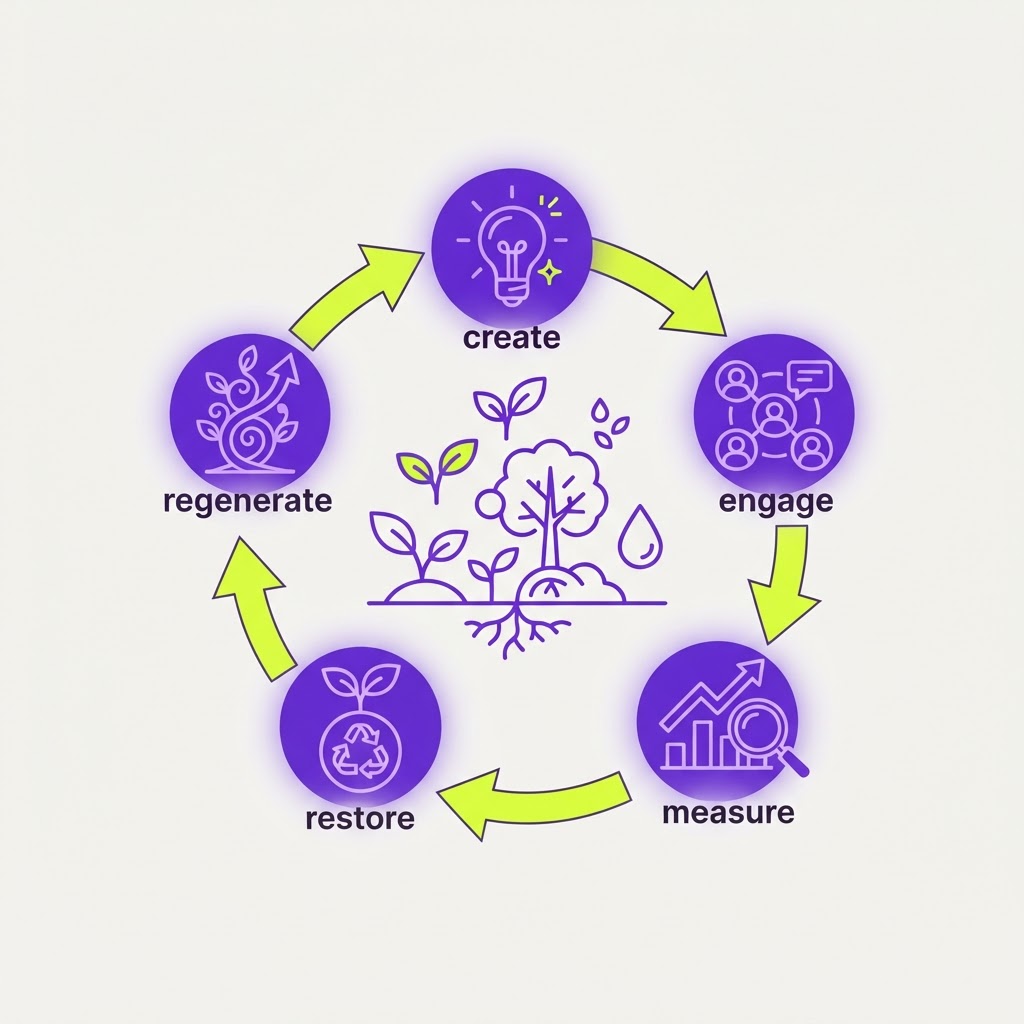
Regenerative marketing is a business growth philosophy that goes beyond sustainability by actively creating positive ecological, social, and economic change through every marketing decision and campaign. Unlike traditional or even sustainable marketing, regenerative marketing treats businesses as participants in living systems — restoring value to communities, ecosystems, and stakeholders rather than merely reducing harm. At its core, it is a 7-step framework that transforms marketing from a resource-consuming function into a force that actively replenishes people, planet, and profit simultaneously.
Core Definition: Regenerative marketing is a 7-step strategic framework that moves brands from extractive, harm-reducing practices to actively restorative ones — generating measurable positive ecological, social, and economic outcomes through every campaign, decision, and stakeholder interaction.
How Is Regenerative Marketing Different from Sustainable Marketing?
This is one of the most common questions marketers ask — and the distinction matters enormously.
| Dimension | Sustainable Marketing | Regenerative Marketing |
|---|---|---|
| Core Goal | Do less harm | Actively create positive change |
| Carbon Approach | Reduce carbon footprint | Sequester and offset carbon net-positively |
| Growth Model | Minimize negative impact | Generate value loops and ecosystems |
| Success Metric | Lower damage scores | Measurable restoration and contribution |
| Stakeholder Role | Inform and comply | Co-create and involve |
| Time Horizon | Short-to-medium term | Long-term systemic transformation |
| Mindset | Risk avoidance | Opportunity creation |
In short: sustainable marketing aims to slow the damage; regenerative marketing aims to reverse it.
What Are the 7 Steps of the Regenerative Marketing Framework?
The 7-step framework provides a sequential, actionable path for brands ready to move from extractive to regenerative practices. Each step builds on the last.
Step 1: Purpose Alignment — What Positive Change Does Your Business Enable?
Regenerative marketing begins with radical honesty about why your business exists. This is not a tagline exercise — it's a strategic audit.
- Define your authentic purpose beyond profit generation
- Map how your products or services create positive change in the world
- Align your marketing messaging with verified, lived organizational values
- Identify the gap between stated purpose and current marketing behavior
Why it matters: Research consistently shows that purpose-driven brands outperform competitors — companies with a clearly defined and activated social purpose grow 2–3x faster than industry averages (Harvard Business Review, 2023).
Step 2: Impact Measurement — How Do You Track What Actually Matters?
If you can't measure it, you can't improve it. Regenerative marketing expands the measurement dashboard beyond revenue.
Track all four impact dimensions:
- Financial performance — revenue, LTV, CAC
- Carbon footprint — emissions generated per campaign, per dollar spent
- Social impact — community benefit, fair wage compliance, diversity outcomes
- Ecosystem contribution — biodiversity, supply chain health, circular resource flows
📊 Benchmark Data: According to the Global Reporting Initiative (GRI), only 14% of marketing teams currently measure social and environmental impact alongside financial KPIs. Brands that do report 21% higher customer retention rates over 3-year periods.
Step 3: Circular Design — How Do You Create Value Loops Instead of Waste?
Circular design means engineering campaigns and touchpoints so that value is continuously regenerated — not consumed once and discarded.
Principles of circular campaign design:
- Every creative asset should have a second (or third) life — repurpose, remix, redistribute
- Packaging, digital assets, and event materials should have zero-waste end-of-life plans
- Customer actions (purchases, shares, referrals) should feed back value into communities or ecosystems
- Partner with suppliers and platforms that operate circular economic models
Example: A campaign that donates 1% of ad spend to reforestation creates a value loop — brand visibility funds ecological restoration, which enhances brand credibility, which drives more campaign ROI.
Step 4: Authentic Storytelling — Why Does Transparency Build More Trust Than Perfection?
Regenerative storytelling is not greenwashing. It requires sharing the real journey — including the setbacks.
- Document and publish your regenerative progress publicly (annual impact reports, live dashboards)
- Share failures and learnings alongside wins — audiences reward vulnerability
- Use verifiable data to back every claim (third-party certifications, audited reports)
- Avoid vague language like