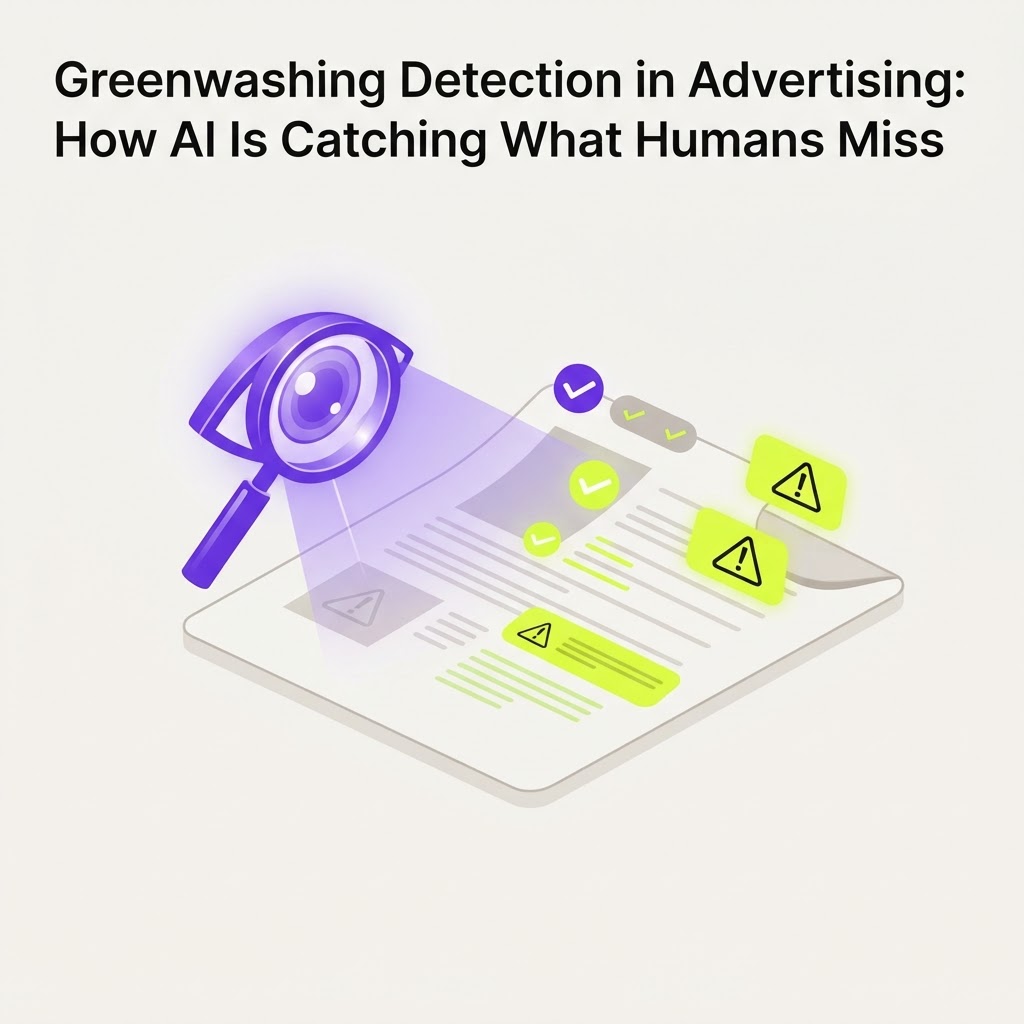
Greenwashing Detection in Advertising: How AI Is Catching What Humans Miss
As the EU Green Claims Directive and FTC Green Guides tighten enforcement, brands can no longer rely on gut feel to vet sustainability claims. Here's how AI-powered greenwashing detection works — and why it matters for your next campaign.
WE7 AI Tool
Is your marketing ECGT-ready? Greenwashing Guard scans every claim in real-time before regulators do.
Greenwashing detection in advertising is the AI-powered process of identifying, risk-scoring, and remediating unsubstantiated, vague, or misleading sustainability claims in marketing materials before they reach consumers or regulators. As the EU Green Claims Directive and FTC Green Guides tighten enforcement from 2026 onward, brands can no longer rely on manual legal review to vet sustainability claims at scale. Here's how AI-powered greenwashing detection works — and why it matters for your next campaign.
Why Is the $2.5 Trillion Greenwashing Problem Impossible to Ignore?
In 2021, the European Commission found that 42% of green claims online were exaggerated, false, or deceptive. By 2026, getting this wrong isn't just a reputational risk — it's a direct legal liability carrying fines, injunctions, and mandatory corrective advertising.
The EU Empowering Consumers for the Green Transition Directive (ECGT), in effect from 2026, bans any sustainability claim that isn't backed by independently verifiable evidence. The UK's Competition and Markets Authority (CMA), the FTC in the US, and regulators across APAC are following suit with parallel frameworks.
For marketing teams, this creates a critical operational challenge: how do you catch a greenwashing claim before it goes live — across hundreds of ad variants, on dozens of channels, in real time?
This challenge sits at the heart of Carbon-First Marketing, a discipline that integrates environmental accountability directly into campaign strategy and execution.
What Is Greenwashing Detection in Advertising?
Greenwashing detection is the systematic process of identifying sustainability claims in marketing materials that fall into one or more of the following five categories:
- Unsubstantiated — no data or evidence behind the claim
- Vague — terms like