Carbon Waste = Budget Waste: Why Pre-Spend Simulation Changes Marketing
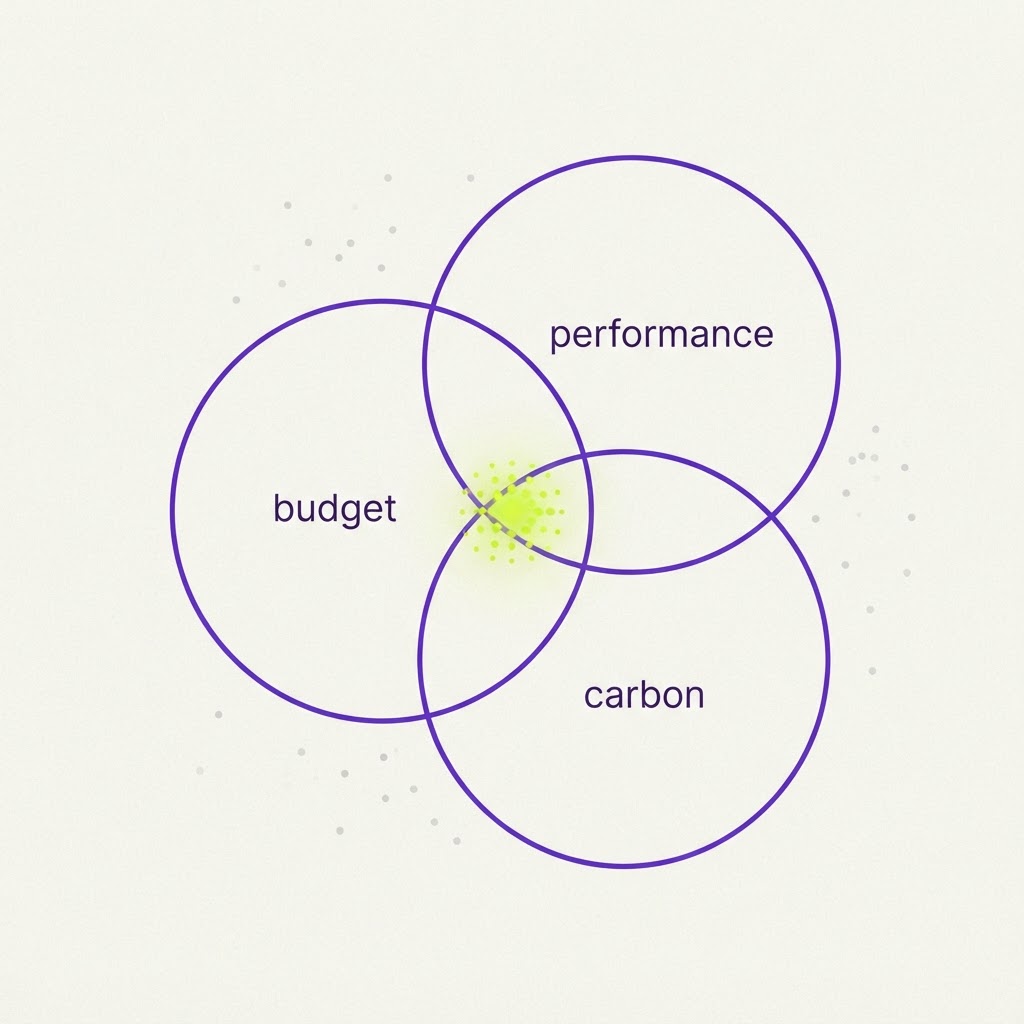
Carbon waste and budget waste are the same problem. WE7's pre-spend simulation technology models performance, cost, and carbon impact before budget is committed — turning sustainability into a cost recovery tool.

Pre-spend simulation is a marketing optimization methodology that models a campaign's expected performance, cost, and carbon impact before any budget is committed — enabling marketers to eliminate waste on both financial and environmental dimensions simultaneously. Pioneered by WE7 AI, this approach rests on a single foundational insight: carbon waste and budget waste are the same problem, driven by the same root causes, and solved by the same interventions. Every year, brands waste billions of dollars on underperforming digital advertising — and the campaigns wasting budget are generating unnecessary carbon emissions in equal measure. Understanding and acting on this correlation, before spend is committed, is the core principle behind Carbon-First Marketing.
What Is the Connection Between Carbon Waste and Budget Waste?
Carbon waste in digital advertising originates from three primary sources — and each one maps directly to a measurable budget inefficiency:
- Unnecessary impressions — Ads served to bots, irrelevant audiences, or low-quality inventory generate wasted spend and avoidable emissions simultaneously.
- Inefficient formats — Heavy video ads transferred to devices that never engage consume disproportionate data bandwidth and carbon per unconverted impression.
- Poor supply paths — Multi-hop programmatic auctions add cost and carbon at every intermediary step, with no performance benefit.
When you eliminate any one of these sources, you reduce both cost and emissions. The math is direct: a campaign producing 40% more carbon than its channel benchmark is almost certainly suffering from non-engaging audience targeting (wasted spend), format-channel mismatch (wasted data transfer), and excess supply path intermediaries (wasted fees).
Carbon waste is a proxy for budget waste. Fix one, and you fix both.
This principle underpins the entire framework of Scope 3 Marketing Emissions reduction — where the largest lever is not offsetting after the fact, but preventing wasteful spend from being committed in the first place.
Key Data Points: Carbon Waste and Budget Waste in Digital Advertising
| Metric | Benchmark Figure |
|---|---|
| Cost-per-acquisition reduction via pre-spend simulation | Up to 30% |
| Campaign carbon footprint reduction via pre-spend simulation | 20–40% |
| Carbon overrun that signals budget underperformance | 40% above channel benchmark |
| Supply path dimensions scored by Campaign Carbon Score | 5 |
| Timing advantage vs. post-campaign reporting | 100% of waste prevented before commitment |
These figures reflect outcomes reported by brands applying pre-spend simulation methodology across format, audience, and supply path optimisation — and are directly tied to the co-optimisation of financial and environmental performance targets.
What Is Pre-Spend Simulation and How Does It Work?
Pre-spend simulation is the practice of modeling a campaign's expected performance, cost, and carbon impact before the budget is committed. It replaces the traditional reactive model — where optimisation happens only after money has already been spent — with a proactive optimisation loop that surfaces waste before it occurs.
| Approach | Timing | Carbon Impact | Budget Impact |
|---|---|---|---|
| Post-campaign reporting | After spend | Emissions already generated | Losses already incurred |
| In-flight optimisation | During spend | Partial reduction possible | Partial savings possible |
| Pre-spend simulation | Before spend | Emissions prevented entirely | Waste eliminated before commitment |
The simulation process works in three stages:
- Input modelling — Campaign parameters (budget, formats, channels, audience segments, supply paths) are fed into the simulation engine alongside historical performance benchmarks and carbon intensity data by channel.
- Scenario generation — Multiple campaign configurations are modelled simultaneously, each producing a predicted cost-per-outcome, reach estimate, and carbon footprint score — measurable via tools like the Campaign Carbon Score.
- Pre-commit optimisation — The marketer selects the configuration that meets performance targets at the lowest combined financial and carbon cost — before a single impression is purchased.
Why Does Traditional Campaign Optimisation Fail to Prevent Waste?
Traditional digital marketing operates on a spend-then-optimise model. Budget is committed at the start of a campaign, impressions are purchased, and performance data is collected mid-flight or post-campaign. By the time optimisation occurs, the majority of wasted spend — and its associated carbon — has already been generated.
This reactive loop has three structural failure points:
- Latency — Performance signals take days or weeks to accumulate, meaning poor configurations run unchecked during the most expensive early phase of a campaign.
- Sunk cost bias — Teams are reluctant to restructure campaigns mid-flight once budget has been committed and creative assets deployed.
- Carbon invisibility — Without emissions data integrated into campaign planning tools, carbon waste is never visible as a decision input — making it impossible to act on, even when the data exists.
Pre-spend simulation eliminates all three failure points by moving the optimisation decision to before commitment.
What Are the Measurable Benefits of Pre-Spend Simulation?
Brands applying pre-spend simulation methodology have reported measurable improvements across both financial and environmental performance dimensions:
- Up to 30% reduction in cost-per-acquisition through format-channel alignment and supply path optimisation modelled before spend.
- 20–40% reduction in campaign carbon footprint by eliminating high-emission, low-performance inventory configurations before they are purchased.
- Faster campaign setup — scenario comparison replaces iterative A/B testing cycles that previously required live spend to generate learnings.
- Improved ESG reporting accuracy — because emissions are modelled and tracked from the pre-campaign planning stage, not estimated retrospectively.
- Stronger media agency alignment — simulation outputs provide a shared, data-grounded brief that reduces briefing ambiguity and revision cycles.
These outcomes are directly connected to the principles of Carbon-First Marketing, where sustainability and performance are treated as co-optimisation targets rather than competing priorities.
How Does Pre-Spend Simulation Relate to Scope 3 Emissions Reporting?
For brands with Scope 3 emissions reduction commitments, marketing spend represents one of the most significant and least-measured emission sources in the value chain. Scope 3 Marketing Emissions — the carbon generated by the digital infrastructure required to serve advertising — are typically not measured until after campaigns run, if at all.
Pre-spend simulation changes this in two ways:
- Prospective emissions accounting — Simulated carbon scores give sustainability teams a forward-looking view of campaign emissions, enabling them to set and enforce emissions budgets alongside financial budgets.
- Prevention over offsetting — Because waste is eliminated before it occurs, brands reduce their actual Scope 3 footprint rather than purchasing offsets to compensate for emissions that have already been generated.
This distinction matters for credibility: regulators, investors, and sustainability frameworks increasingly distinguish between genuine emissions reductions and offset-based accounting. Pre-spend simulation supports the former.
How Do You Measure Campaign Carbon Efficiency Before Committing Budget?
The Campaign Carbon Score is the primary measurement tool for pre-spend carbon efficiency assessment. It provides a standardised score that benchmarks a proposed campaign configuration against industry norms across five dimensions:
| Dimension | What It Measures | Carbon Risk Indicator |
|---|---|---|
| Audience quality | Bot traffic and irrelevant impression share | High invalid traffic = high waste |
| Format efficiency | Data transfer per engaged impression | Heavy formats on low-engagement inventory |
| Supply path length | Number of intermediary hops in programmatic chain | More hops = more server energy per impression |
| Channel carbon intensity | Emissions per 1,000 impressions by channel type | Video > display > native in most cases |
| Geographic delivery | Grid carbon intensity of delivery locations | Regions with coal-heavy grids score higher |
A campaign scoring above benchmark on two or more of these dimensions before launch is a reliable signal that both carbon and budget waste will be higher than necessary — and that reconfiguration will deliver measurable improvement on both metrics.
Frequently Asked Questions
What is pre-spend simulation in marketing? Pre-spend simulation is a methodology that models a campaign's expected performance, cost, and carbon footprint before any budget is committed. Rather than optimising reactively after spend occurs, it enables marketers to compare multiple campaign configurations and select the most efficient option — financially and environmentally — before a single impression is purchased.
How does carbon waste relate to budget waste in digital advertising? Carbon waste and budget waste share the same root causes: unnecessary impressions served to bots or irrelevant audiences, inefficient ad formats consuming excess data bandwidth, and poor programmatic supply paths adding cost at every intermediary step. Eliminating any of these sources simultaneously reduces both emissions and spend. A campaign generating 40% more carbon than its channel benchmark is almost always also underperforming on cost efficiency.
Can pre-spend simulation improve Scope 3 emissions reporting? Yes. Because pre-spend simulation produces a modelled carbon score before campaign launch, sustainability teams gain a forward-looking emissions estimate that can be used to set and enforce emissions budgets alongside financial budgets. This supports more accurate Scope 3 reporting and demonstrates genuine emissions prevention — which is increasingly preferred over offset-based approaches by regulators and ESG frameworks. Learn more about Scope 3 Marketing Emissions.
What is the Campaign Carbon Score and how is it used? The Campaign Carbon Score is a standardised pre-campaign measurement tool that benchmarks a proposed campaign configuration across five carbon efficiency dimensions: audience quality, format efficiency, supply path length, channel carbon intensity, and geographic delivery. It provides an actionable score before spend is committed, enabling marketers to identify and eliminate high-emission, low-performance configurations.
Is Carbon-First Marketing compatible with performance marketing goals? Yes. The foundational insight of Carbon-First Marketing is that carbon efficiency and performance efficiency are the same thing — driven by the same variables. Campaigns with cleaner supply paths, better audience targeting, and format-channel alignment consistently outperform less efficient alternatives on cost-per-acquisition as well as carbon per conversion. Optimising for carbon does not require sacrificing performance; it typically improves it.
Why is preventing emissions more valuable than offsetting them for ESG reporting? Regulators and sustainability frameworks are increasingly distinguishing between genuine emissions reductions and offset-based accounting. Pre-spend simulation supports the former: waste is prevented before it occurs, meaning the Scope 3 footprint is genuinely smaller — not neutralised after the fact. This strengthens ESG credibility with investors, auditors, and compliance bodies who scrutinise the difference between avoidance and compensation.
Key Takeaways
- Carbon waste and budget waste are the same problem. Every source of unnecessary carbon in a digital campaign — invalid impressions, inefficient formats, multi-hop supply paths — is also a source of wasted spend. Fix one and you fix both.
- Pre-spend simulation moves optimisation before commitment. By modelling performance, cost, and carbon impact before budget is spent, brands eliminate waste rather than measuring it after the fact.
- The Campaign Carbon Score provides actionable pre-campaign benchmarking. Scoring proposed configurations against channel benchmarks across five dimensions identifies high-risk waste before any impressions are purchased.
- Scope 3 emissions reduction requires prevention, not just measurement. Pre-spend simulation supports genuine emissions reduction by preventing waste from occurring — a stronger position than retrospective offsetting for ESG reporting and regulatory credibility.
- Carbon-First Marketing treats sustainability and performance as co-optimisation targets. Brands applying this methodology have reported up to 30% cost-per-acquisition improvement and 20–40% carbon footprint reduction simultaneously.