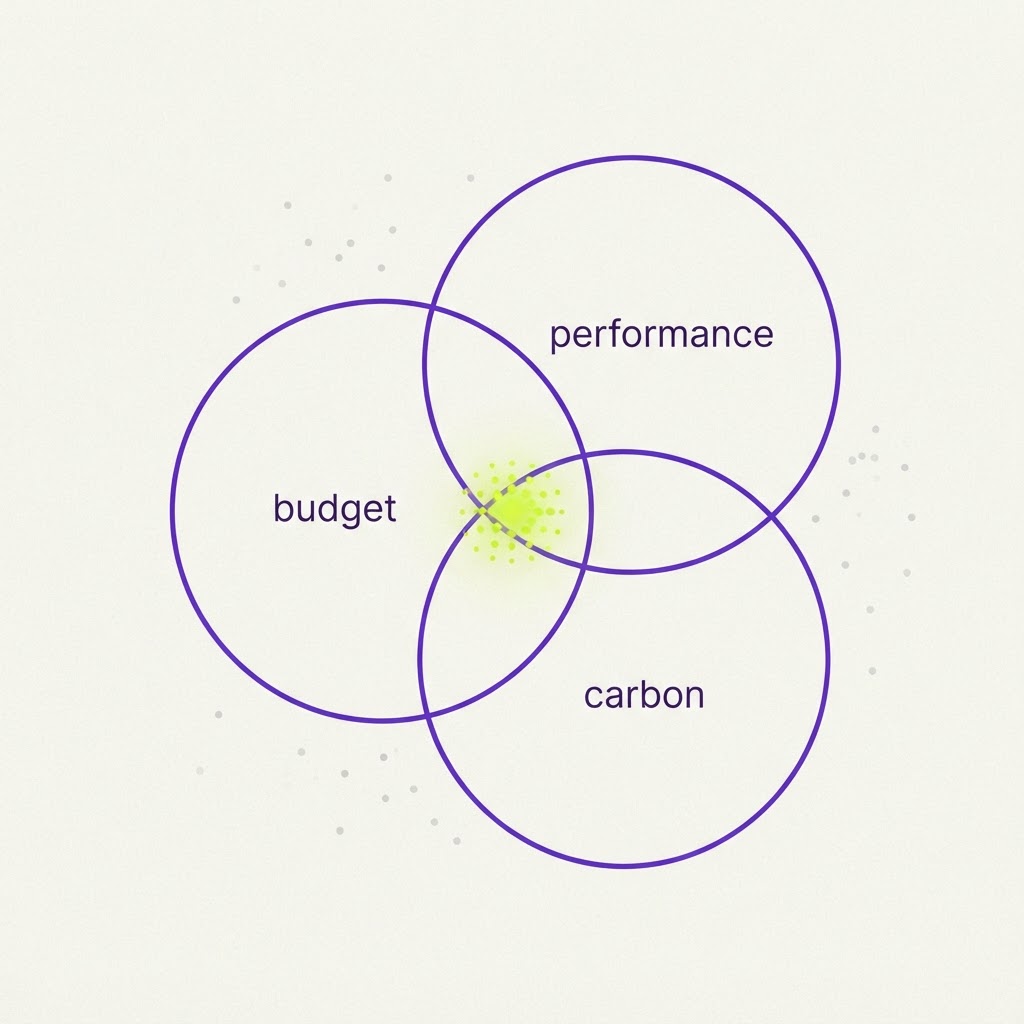
Carbon-Adjusted ROAS: The Marketing Metric That Changes Everything
Carbon-Adjusted ROAS is the next evolution of return on ad spend — recalculating campaign performance to account for carbon cost. Here's why it matters and how to calculate it.

Carbon-Adjusted ROAS (CA-ROAS) is a composite marketing performance metric that recalculates return on ad spend to incorporate the full carbon cost of a campaign — producing a single figure that reflects both financial return and environmental efficiency. Calculated as Revenue Generated ÷ (Ad Spend + Carbon Cost), CA-ROAS is the next evolution of ROAS for the full-cost accounting era. In 2026, as Scope 3 emissions reporting becomes mandatory under CSRD and IFRS S2, CA-ROAS is shifting from a sustainability nice-to-have to a material business requirement.
What Is Carbon-Adjusted ROAS and How Does It Work?
Carbon-Adjusted ROAS (CA-ROAS) is a composite performance metric that recalculates return on ad spend to incorporate the carbon cost of a campaign.
The formula is straightforward:
CA-ROAS = Revenue Generated ÷ (Ad Spend + Carbon Cost)
Where carbon cost is the financial equivalent of the campaign's carbon emissions — calculated using either a company's internal carbon price or a standardised market rate.
The result is a single number that tells you not just how much revenue your campaign generated per pound of spend, but how efficiently it generated that revenue relative to its total cost — including its environmental cost.
Why Is Standard ROAS No Longer Enough?
For the past decade, ROAS — return on ad spend — has been the defining performance metric for digital marketing. Every campaign is measured against it. Every budget decision is justified by it. Every agency pitch leads with it.
But ROAS has a blind spot: it measures financial return without accounting for environmental cost. Consider two campaigns with identical ROAS of 4.2x:
- Campaign A achieved this through a programmatic video strategy with heavy retargeting — high impression volume, high carbon intensity
- Campaign B achieved this through contextual display and email nurture — lower volume, significantly lower carbon footprint
On standard ROAS, these campaigns are identical. On Carbon-Adjusted ROAS, Campaign B outperforms Campaign A by a meaningful margin.
That difference matters for three reasons:
- Regulatory compliance. Under CSRD and IFRS S2, Scope 3 marketing emissions are becoming reportable. A high-carbon campaign that delivers the same revenue as a low-carbon alternative is not a neutral choice — it is an inefficiency with a compliance cost.
- Brand equity. Consumer research consistently shows that sustainability credibility drives purchase intent among the fastest-growing consumer segments. A campaign strategy that quietly erodes your sustainability positioning while delivering short-term ROAS is destroying long-term brand value.
- True cost accounting. Carbon has a cost. Whether priced through internal carbon pricing, regulatory penalties, or offset investment, that cost is real. CA-ROAS is simply honest accounting.
Key Data Points: The Business Case for CA-ROAS
| Metric | Benchmark |
|---|---|
| Typical internal carbon price range | $15–$150 per tonne CO₂e |
| ROAS difference between high- and low-carbon campaigns | Meaningful margin on identical 4.2x standard ROAS |
| Regulatory frameworks requiring Scope 3 reporting | CSRD (EU), IFRS S2 (global) — effective from 2024–2026 |
| Strategic reallocation opportunity at enterprise scale | Tens of millions in marketing budget |
| Channels most carbon-inefficient | Programmatic video + retargeting |
| Channels most carbon-efficient | Content marketing + email nurture |
How Do You Calculate Carbon-Adjusted ROAS?
Calculating CA-ROAS follows a clear three-step process:
Step 1: Establish campaign carbon footprint
Measure the total emissions of your campaign across:
- Digital media buying (impressions, video views, clicks)
- Creative production
- Data processing and targeting infrastructure
Step 2: Apply a carbon price
Use your organisation's internal carbon price — typically $15–$150 per tonne CO₂e — to convert emissions into a financial figure.
Step 3: Recalculate ROAS
Add the carbon cost to your ad spend denominator and recalculate using the CA-ROAS formula.
WE7 AI automates this calculation in real time — across every campaign, channel, and market — and surfaces it in the same dashboard where your standard performance metrics live.
What Does CA-ROAS Reveal That Standard ROAS Doesn't?
When marketing teams first see CA-ROAS data alongside standard ROAS, three patterns consistently emerge:
- Programmatic campaigns underperform — high impression volume inflates ROAS but carries disproportionate carbon cost
- Retargeting is carbon-inefficient — the incremental revenue gain rarely justifies the carbon overhead
- Content and email significantly outperform — low carbon intensity, high conversion efficiency
These are not small differences. They represent strategic reallocation opportunities worth tens of millions in enterprise marketing budgets.
How Does WE7 AI Make CA-ROAS Actionable at Scale?
Calculating CA-ROAS is the first step. Acting on it — at the speed and scale of modern digital marketing — requires something fundamentally different: intelligence.
WE7 AI was built from the ground up to close that gap. The platform doesn't just surface CA-ROAS data. It reasons about it, learns from it, and tells you exactly what to do next.
What Is WE7 AI's Proprietary Recommendation Intelligence?
Most platforms show you what happened. WE7 AI tells you what to do about it.
The AI engine continuously analyses campaign performance across the carbon-performance spectrum and generates ranked, prioritised recommendations — not generic suggestions, but specific, contextualised actions calibrated to your budget, your targets, and your risk tolerance.
The intelligence layer works across three dimensions simultaneously:
- Performance optimisation — maximising revenue and conversion efficiency
- Carbon reduction — minimising emissions per pound of spend
- Compliance readiness — ensuring actions align with CSRD, IFRS S2, and internal carbon commitments
No other platform optimises across all three at once.
How Does WE7 AI Handle Machine Learning Without a Black Box?
WE7 AI's machine learning models are trained on a proprietary combination of:
- Campaign performance data
- Carbon emission factors
- Channel efficiency benchmarks
- Regulatory frameworks
The models evolve continuously as new data flows in. But WE7 AI made a deliberate architectural choice: explainability over opacity. Every recommendation surfaces its reasoning. You see not just what the AI suggests — but why, what tradeoff it's making, and what the projected outcome is.
This matters for marketing leaders who need to justify decisions internally, present to sustainability committees, and satisfy auditors. AI that can't explain itself creates risk. WE7 AI eliminates that risk.
What Is Decision Intelligence at Campaign Speed?
WE7 AI's Decision Intelligence layer translates CA-ROAS insights into real-time campaign signals across three stages:
- Pre-launch carbon forecasting — before you spend a pound, the system predicts the campaign's CA-ROAS range based on your proposed channel mix
- In-flight optimisation signals — as campaigns run, the AI detects carbon-performance divergence and flags reallocation opportunities
- Post-campaign learning — every campaign outcome feeds back into the model, making future recommendations sharper
The result is a self-improving intelligence loop that gets better at predicting the intersection of carbon efficiency and business performance the more you use it.
How Does WE7 AI Compare to Standard Analytics Platforms?
| Capability | Standard Analytics Platforms | WE7 AI |
|---|---|---|
| Carbon measurement | ✗ | ✓ Real-time, cross-channel |
| CA-ROAS calculation | ✗ | ✓ Automated |
| AI recommendations | Generic performance only | Carbon + performance + compliance |
| Explainability | Limited | Full reasoning surfaced |
| Pre-launch forecasting | ✗ | ✓ ML-powered |
| Regulatory alignment | ✗ | ✓ CSRD, IFRS S2 ready |
Why Does CA-ROAS Matter for CMOs and Marketing Leaders?
CA-ROAS is not a niche sustainability metric. It is the next evolution of performance marketing — the natural extension of ROAS into the full-cost accounting era.
The CMOs who adopt it now will be:
- Ahead of mandatory reporting requirements under CSRD and IFRS S2
- Ahead of consumer expectations driven by sustainability credibility
- Ahead of competitors who are still optimising for a metric that no longer tells the whole story
With WE7 AI's intelligence engine behind it, CA-ROAS isn't just a number to report. It's a signal that drives smarter decisions, faster — at every stage of the campaign lifecycle.
Frequently Asked Questions
Q: What is the difference between ROAS and Carbon-Adjusted ROAS?
A: Standard ROAS measures revenue generated per pound of ad spend. Carbon-Adjusted ROAS (CA-ROAS) adds the financial equivalent of a campaign's carbon emissions to the denominator — so it measures revenue generated per pound of total cost, including environmental cost. Two campaigns with identical ROAS can have very different CA-ROAS scores depending on their carbon intensity.
Q: How is carbon cost calculated for a marketing campaign?
A: Carbon cost is calculated by first measuring total campaign emissions across digital media buying, creative production, and data infrastructure, then multiplying by a carbon price — typically $15–$150 per tonne CO₂e, depending on whether you use an internal carbon price or a market rate. This converts emissions into a financial figure that can be added to your ad spend denominator.
Q: Which marketing channels have the highest carbon intensity?
A: Programmatic video and retargeting campaigns consistently show the highest carbon intensity relative to revenue generated. Content marketing and email nurture campaigns show the lowest carbon intensity — and when CA-ROAS is applied, these channels frequently outperform channels that appear stronger on standard ROAS alone.
Q: Is CA-ROAS required for regulatory compliance?
A: CA-ROAS itself is not a mandated metric, but the underlying data it relies on — Scope 3 emissions from marketing activities — is becoming reportable under CSRD (EU) and IFRS S2 (global), with requirements phasing in from 2024 through 2026. CA-ROAS provides the operational framework for marketing teams to act on that data rather than simply report it.
Q: How quickly can a company start using Carbon-Adjusted ROAS?
A: With the right platform, CA-ROAS can be calculated in real time from existing campaign data. WE7 AI automates the carbon measurement, pricing, and ROAS recalculation process across all channels simultaneously — meaning marketing teams do not need to build new data infrastructure to get started.
Key Takeaways
- CA-ROAS is defined as Revenue ÷ (Ad Spend + Carbon Cost) — a single metric that reflects both financial return and environmental efficiency, closing the blind spot in standard ROAS.
- Two campaigns with identical ROAS can have significantly different CA-ROAS scores — programmatic and retargeting strategies are typically the most carbon-inefficient; content and email are the most efficient.
- The internal carbon price range of $15–$150 per tonne CO₂e translates emissions into a real financial figure that belongs in every marketing budget calculation.
- Regulatory pressure is accelerating adoption — CSRD and IFRS S2 are making Scope 3 marketing emissions reportable, turning CA-ROAS from a best practice into a compliance necessity.
- Actionable CA-ROAS requires intelligence, not just measurement — platforms like WE7 AI automate calculation, surface explainable recommendations, and optimise across performance, carbon, and compliance simultaneously.