40% of Paid Media Is Never Seen by a Human
Ad fraud, bot traffic, and invalid impressions silently consume nearly half of global digital ad budgets. Here is what the data says — and what AI-driven waste elimination can do about it.

Ad fraud, bot traffic, and invalid impressions are a category of digital advertising waste in which paid media spend is consumed by non-human traffic, invisible placements, and fraudulent publishers — delivering zero business value while still incurring full cost. According to multiple independent research bodies, this waste accounts for approximately 40–45% of total programmatic spend in open exchange environments, making it one of the largest and most persistent sources of financial loss in modern marketing.
Why Is Nearly Half of All Paid Media Never Seen by a Human?
Every year, the global digital advertising industry reports record spending. And every year, a staggering proportion of that spend is consumed by bots, fraudulent publishers, and invisible placements that no human ever sees.
This is not a fringe problem. It is one of the most significant and persistent sources of financial waste in modern marketing — and most CMOs have only a partial picture of how much it is costing them.
What Does the Data Actually Say About Ad Fraud and Wasted Spend?
The numbers are well-documented, even if they are rarely discussed in boardrooms.
Benchmark Data: Ad Fraud and Media Waste by the Numbers
| Source | Finding | Year |
|---|---|---|
| ANA (Association of National Advertisers) | Ad fraud costs advertisers $84 billion globally; projected to exceed $100 billion by 2026 (up from $35B in 2018) | 2023 |
| CHEQ / University of Baltimore | Invalid traffic (IVT) accounts for 36–40% of monetised web traffic in programmatic environments | 2023 |
| Integral Ad Science (IAS) Industry Pulse | Display viewability rates average 68–72%, meaning 28–32% of served impressions are never in-view | 2023 |
| DoubleVerify Global Insights Report | Sophisticated Invalid Traffic (SIVT) increased 17% year-on-year across programmatic environments | 2023 |
| WARC / GroupM | Combined fraud, non-viewable inventory, and brand safety violations result in 40–45% effective media quality loss in open exchange programmatic | 2024 |
Read those figures again. Between fraud, bot traffic, and non-viewable placements, brands are losing close to half their programmatic budgets before a single real human has the opportunity to see the ad.
For a brand spending $10 million on digital advertising, that represents approximately $4 million generating no business outcome, no human connection — while still consuming server load, data centre electricity, and carbon emissions.
What Are the Three Main Categories of Paid Media Waste?
It helps to separate the problem into its component parts.
1. Invalid Traffic (IVT) and Ad Fraud
This includes:
- General Invalid Traffic (GIVT): Known data centres, crawlers, and bots
- Sophisticated Invalid Traffic (SIVT): Mimics human behaviour through hijacked devices, click farms, and domain spoofing
SIVT is particularly damaging because it passes through basic verification filters undetected.
The programmatic supply chain's complexity makes fraud easier to hide. The longer the auction path — the more SSPs, exchanges, and resellers involved — the more opportunities exist for fraudulent inventory to enter the ecosystem. Studies by the Path to Purchase Institute found that auction paths with four or more hops had significantly higher rates of IVT than direct or two-hop paths.
2. Non-Viewable Impressions
An impression is counted the moment an ad tag fires. It does not require the ad to be on screen. The MRC (Media Rating Council) standard defines a display ad as viewable only if:
- At least 50% of its pixels are in-view
- For at least one continuous second (two seconds for video)
Even on reputable publishers, a significant portion of inventory fails this threshold — loaded below the fold, in cluttered page environments, or on pages with high bounce rates. The impression was served. The budget was charged. The human never looked.
3. Audience Mismatch and Budget Misallocation
Beyond fraud and viewability, there is the more mundane but equally costly problem of targeting inefficiency. Campaigns that reach real, viewable audiences who have no intent to convert are not fraudulent — they are simply wasted. Industry benchmarks suggest that 20–30% of campaign reach in broad-audience programmatic falls into this category.
Why Does Ad Fraud Persist Despite Industry Awareness?
The uncomfortable truth is that parts of the ad tech ecosystem are financially incentivised to allow waste to continue.
Intermediaries — DSPs, SSPs, ad networks, and data brokers — are paid on volume. More impressions served means more fees collected. The brand pays for 10 million impressions; the intermediary takes a margin on all 10 million, regardless of whether 4 million of them were bots.
Verification vendors help, but they operate on a detection model — identifying and blocking known bad inventory after it enters the buying process. They are reactive by design. By the time a fraudulent domain is blacklisted, the operator has already moved infrastructure and is generating new inventory under a new identity.
Pre-bid intelligence — eliminating waste before the auction rather than after — is where the structural shift needs to happen.
What Is the Environmental Cost of Ad Fraud?
There is a dimension to this waste that most advertising analyses ignore entirely: the carbon footprint.
Every impression — fraudulent or real, viewable or non-viewable — consumes electricity. Ad auctions run in data centres. Creative assets are delivered through CDNs. Measurement pixels fire on every page load. The carbon footprint of a programmatic campaign is real and measurable, and a substantial portion of it is generated by activity that delivers zero business value.
A campaign where 40% of impressions are invalid or non-viewable is not just financially wasteful. It is generating emissions with no corresponding return. As Scope 3 reporting requirements tighten and marketing carbon footprint becomes a disclosure issue, the financial waste problem and the emissions waste problem converge — making this simultaneously a CFO issue and a CSO issue.
How Does AI-Driven Waste Elimination Change the Equation?
The conventional response to ad fraud has been verification and brand safety tooling: blacklists, viewability filters, third-party auditing. These are necessary but insufficient. They address symptoms rather than structure.
A fundamentally different approach applies AI upstream of the buying decision, analysing:
- Supply chain paths and auction hop counts
- Publisher quality signals and historical performance data
- Audience composition and intent match rates
- Carbon intensity per impression
This is the model behind WE7 AI Ad Waste Elimination. Rather than filtering bad impressions after they enter the plan, the system scores campaign routes and inventory sources against a composite quality index — incorporating IVT risk, viewability probability, audience match rate, and carbon intensity — and surfaces the highest-value, lowest-waste paths before launch.
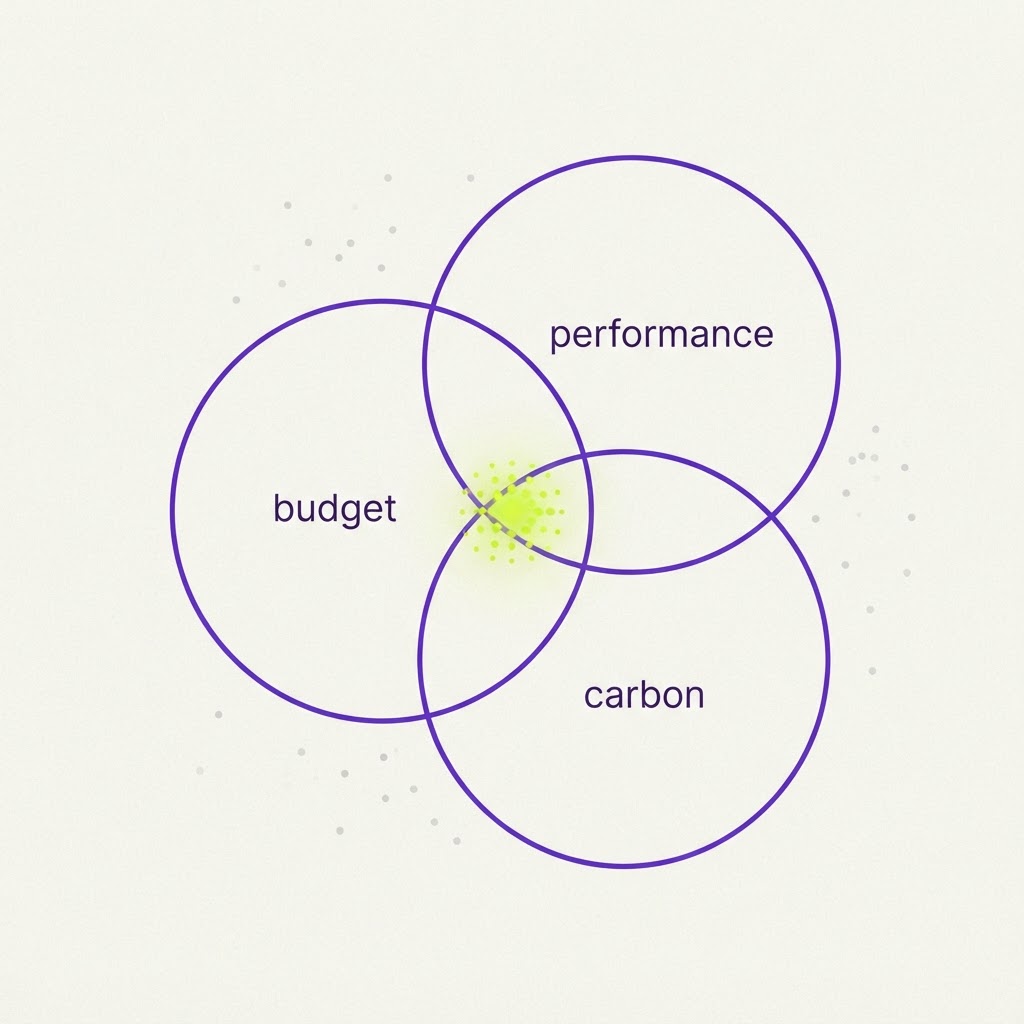
The insight that consistently emerges from this analysis: cleaner supply chains perform better on every dimension simultaneously. Shorter auction paths reduce fraud exposure, improve viewability, and lower carbon intensity. The waste elimination decision and the performance optimisation decision are the same decision.
What Should Brands Change About How They Buy Media?
The industry has the data to act on this problem. What it often lacks is the organisational will to prioritise quality over volume.
Four structural shifts make the biggest difference:
- Supply Path Optimisation (SPO): Reduce the number of intermediaries between buyer and publisher, shorten auction paths, and establish direct relationships with premium inventory sources.
- Pre-Bid AI Scoring: Apply machine learning to historical impression-level data to predict IVT risk and viewability probability before committing budget.
- Carbon-Integrated Planning: Treat emissions efficiency as a planning variable alongside CPM and reach — not as a separate sustainability exercise.
- Outcome-Linked Verification: Tie media quality metrics to business outcomes rather than proxy metrics like CTR, which can be inflated by low-quality traffic.
Key Data Points at a Glance
- 📊 $84 billion lost to ad fraud globally in 2023 (ANA)
- 📊 $100 billion+ projected ad fraud cost by 2026 (ANA)
- 📊 36–40% of programmatic web traffic is invalid (CHEQ/University of Baltimore)
- 📊 28–32% of served display impressions are never in-view (IAS, 2023)
- 📊 17% year-on-year increase in Sophisticated Invalid Traffic (DoubleVerify, 2023)
- 📊 40–45% effective media quality loss in open exchange programmatic (WARC/GroupM, 2024)
- 📊 20–30% of broad-audience programmatic reach targets users with no conversion intent
- 📊 $4 million in wasted spend for every $10 million digital ad budget
Frequently Asked Questions
Q: What percentage of digital ad spend is wasted on fraud and non-viewable impressions?
A: According to WARC and GroupM data from 2024, when combining fraud, non-viewable inventory, and brand safety violations, effective media quality loss reaches 40–45% of total programmatic spend in open exchange environments. This is consistent with findings from CHEQ, IAS, and DoubleVerify across multiple years.
Q: What is the difference between GIVT and SIVT in ad fraud?
A: General Invalid Traffic (GIVT) includes easily detectable non-human activity such as known data centres, crawlers, and basic bots. Sophisticated Invalid Traffic (SIVT) is far more dangerous — it mimics human browsing behaviour through hijacked devices, click farms, and domain spoofing, and typically bypasses standard verification filters. DoubleVerify reported a 17% year-on-year increase in SIVT in 2023.
Q: What is the MRC viewability standard for digital advertising?
A: The Media Rating Council (MRC) defines a display ad as viewable if at least 50% of its pixels are in-view for a minimum of one continuous second. For video ads, the requirement is 50% in-view for two continuous seconds. Despite this relatively low bar, IAS data shows that 28–32% of served display impressions still fail to meet it.
Q: How does AI help eliminate ad waste before it happens?
A: AI-driven waste elimination works upstream of the buying decision by scoring supply chain paths, publisher quality signals, audience composition, and historical IVT rates before budget is committed. This pre-bid approach is structurally different from reactive verification tools, which only detect and block known bad inventory after it has already entered the buying process.
Q: Is ad fraud also an ESG or sustainability issue?
A: Yes. Every programmatic impression — including fraudulent and non-viewable ones — consumes electricity through data centre auctions, CDN delivery, and measurement pixel firing. A campaign where 40% of impressions are invalid is generating real carbon emissions with zero business return. As Scope 3 reporting requirements expand, the financial and environmental costs of ad waste are increasingly converging into a single strategic issue for CMOs and CSOs alike.
Q: Why do intermediaries in the ad tech ecosystem have little incentive to reduce fraud?
A: DSPs, SSPs, ad networks, and data brokers are compensated on impression volume, not impression quality. This means they collect their margin on every impression served — including the estimated 40% that are invalid or non-viewable. Until buying contracts are restructured around verified quality outcomes rather than gross volume, the financial incentive to address waste remains misaligned with the advertiser's interest.
Key Takeaways
- Ad fraud is not a fringe issue — independent research from ANA, IAS, DoubleVerify, and WARC consistently confirms that 40–45% of programmatic spend in open exchange environments is effectively wasted through fraud, non-viewable inventory, and brand safety violations.
- The ad tech ecosystem has structural incentives to sustain waste — intermediaries paid on volume have little financial motivation to reduce invalid impressions, making external AI-driven pre-bid scoring essential.
- Reactive verification tools are insufficient — blacklists and viewability filters address symptoms after the fact; eliminating waste requires intelligence applied before the auction, not after.
- Cleaner supply chains improve performance on every dimension simultaneously — shorter auction paths reduce fraud exposure, improve viewability rates, and lower carbon intensity, meaning waste elimination and performance optimisation are the same decision.
- This is both a financial and ESG issue — for a $10M digital ad budget, approximately $4M generates no human value while still producing server load and carbon emissions, making ad waste a material concern for CFOs, CMOs, and sustainability officers alike.
Sources: ANA/White Ops Bot Fraud Study 2023; CHEQ/University of Baltimore Economic Cost of Bad Actors Online 2023; Integral Ad Science H2 2023 Industry Pulse; DoubleVerify Global Insights Report 2023; WARC/GroupM This Year Next Year 2024; MRC Viewability Standards; Path to Purchase Institute Programmatic Supply Chain Audit 2022.